What does it mean to say, “I’m going to sail around the world?” Where does such an idea come from? Is it completely crazy? And how do you even go about doing it? How do you know which way to head? What is going to happen when you do it? How will others share in the experience?
Let me try to answer some of these questions here by way of introducing you to Bodacious Dream Expeditions.
:: THE BODACIOUS DREAM
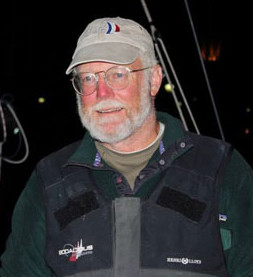 Since I was a teenager on the shores of Lake Michigan, my undying passion and ever-present dream has been to race a boat around the world sailed only by myself. There’s a simplicity to such a dream, a simplicity that involves putting myself, my boat and my skills to a test that only I can pass or fail. Mix those simple variables with the infinitely more complex ones of the ocean, the weather and the wind – none of which offer any possible certainty, and suddenly you have the makings of a very one-of-a-kind story that then unfolds against the backdrop of the entire planet and over her vast oceans. How can such an experience not offer up an inexhaustible number of unique opportunities that simply beg to be shared … and which now CAN be shared, via a persistent satellite Internet connection.
So, my dream has evolved into a two part dream … to not only make the long-dreamed of journey, but to also share it – as it happens – with curious minds around the world, both younger and older.
With a boat and plans in place, my dream stalled waiting for the “Global Ocean Race” to materialize. As the organizers moved the race from 2013 to next year (or possibly later,) we decided to press forward on our own … and to sail the same course as the Global Ocean Race, but to do it in our own way, and in our own time, and so allow ourselves the chance to explore more deeply the wonders of the marine world along that same course, and to do our best to capture the experience in story, photos and video, turning each day into a learning opportunity for kids and adults who might not otherwise have access to these distant and remote corners of the world, or to the many lessons hidden there.
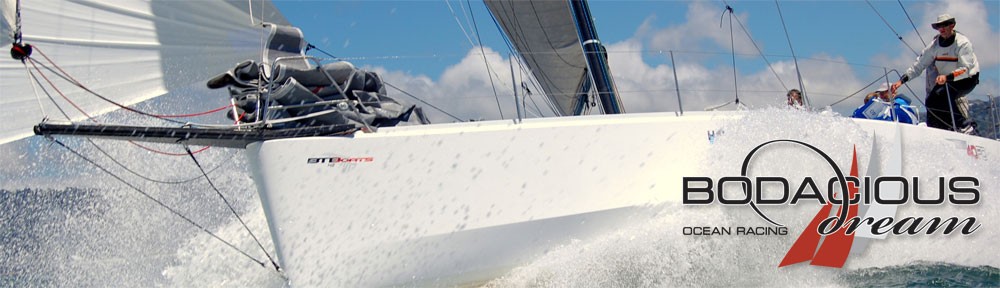
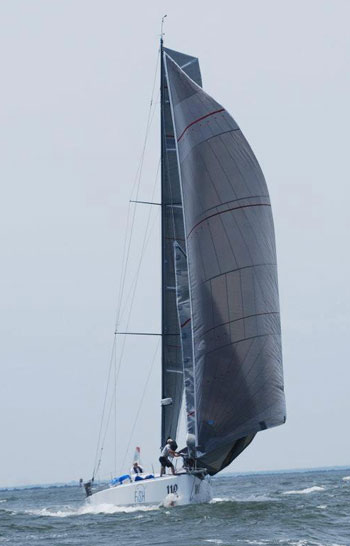
Bodacious Dream, our boat, is a 40-foot long, Class 40 sail racing boat. She was designed to sail and race long distances by a single individual and was constructed to withstand the forces of nature that rise in the wilder regions of the world’s oceans. Bodacious Dream will be my home, my transport, my mobile learning lab and my media communications studio. As I sail the remote ocean course and meet each day’s challenges, I will be sharing those events and discoveries with you.
:: OUR GLOBAL EXPEDITION
Our adventure will begin October 1st, 2013 in Newport, Rhode Island and head south to the equator before heading eastward around the world, following the traditional race routes of the major solo circumnavigating races of the world, such as the original BOC and Around Alone races, now both renamed the Velux 5 Oceans Race, the Global Ocean Race and the Vendée Globe.
From Newport, the course will run approximately 30,000 miles in a complete circumnavigation and take approximately 9 months. Unconfined by the competitive race format, we’ll have the luxury of time to explore and experience some of the more interesting and remote regions in the world, mostly inaccessible without a boat, and there capture interesting data and record events to upload to the Internet and to make available to everyone … including teachers, scientists and organizations such as our partners at Earthwatch Institute.
:: LEARNING AND DISCOVERY
Believing that some of the most valuable learning follows from the sharing of engaging experiences, we will be complementing our real-life experiences and reports en route with our Expedition “Explorer Guides”— fun and engaging work sheets containing questions, facts and details on specific regions and subjects – so that younger minds can visually and experientially experience our expeditions and apply more traditional education methods … but as departure points for real-world problem-solving.
Our Explorer Guides are intended to kick start interaction and conversation and to encourage mentorship on the part of parents and relatives. Their focus will range from simple time and distance math equations specific to our course and navigation to more complex trigonometry-focused celestial navigation as well as natural, environmental and ocean-related fact-based science, history, human physiology, engineering and other subjects that we ourselves become exposed to along the way. It will be a learning opportunity as much for us as for all of you as we progress around the world.
Such a model of co-learning as I’m outlining here may well be applicable when it comes to discovery and learning in other aspects of life. When building upon direct experience, one begins to understand a somewhat simpler definition of intelligence; one that follows from close observation that engages us to better understand basic human instincts, intuitions, naturally occurring patterns and logical consequences and then overlaying and comparing those insights with the various unsolved questions that we encounter along the way. Such a process can help us to eliminate certain unlikely and unreasonable options before distilling down to a few simpler and hopefully more elegant solutions.
:: THE ROUTE:
[NOTE: What follows here is a general summary of the route. A more specific intinerary with map images and coordinates can be found HERE!]
The Atlantic Ocean: The route will take me from Newport, RI on the Northeast coast of the United States south through the Caribbean during late hurricane season – amid its many weather variables. Once we pass below the hurricane zone, we will continue towards the mouth of the Amazon River off the coast of Brazil and there explore this amazing river at the point where its fresh waters mix with the salty waters of the Atlantic Ocean. The mouth of the Amazon is more than 280 miles wide and this blending of fresh and ocean waters extends in some areas 100 miles out to sea. Such a vibrant environment has created many adaptations in various species that live within these co-mixed waters and serve to exemplify the grand tolerance and resiliency that exists in nature, and that might positively be applied to our thinking about human civilization.
From the mouth of the Amazon, we will proceed eastward towards Cape Town, South Africa stopping first at one of the remote islands of St. Helena. These very isolated islands with their unique topography and wildlife are among the very few landmasses near the center of the Atlantic Ocean.
The Indian Ocean: After exploring the areas around Cape Town, South Africa and the amazing coastal whale habitats just east of there, I will again head east towards New Zealand making a stop in the Keruglen Islands before continuing across the vast expanse of the Indian Ocean towards Wellington, New Zealand. The Kerugelan Islands are a very remote group of islands in the high latitudes of the Indian Ocean. These beautiful but desolate islands are often only used as a stopping point for ships and vessels in need of repair.
The Pacific Ocean: The many amazing natural features of New Zealand will keep us engaged for a few weeks as we prepare for the most desolate passage of the trip through the Southern Ocean from Wellington, New Zealand to Cape Horn. Known as the “Everest of Sailing,” Cape Horn is the southernmost tip of South America and legendary for its drastic weather changes as the massive expanses of the Southern Pacific and Southern Atlantic oceans converge here. Our plan, weather permitting, will be to take a day or two and explore this wild and majestic region before heading up the coast and entering into the Straights of Magellan – the passage way through Tierra Del Fuego that was named for the Spanish Explorer Ferdinand Magellan who passed through it in the 1600’s.
The Atlantic Ocean: From the Straights of Magellan, I will make the short passage to the Falkland Islands and explore this remote island group and incredible natural habitat – though it is probably best known from the political confrontation that took place in the 1980s between Argentina and England over the island’s sovereignty rights.
From the Falkland Islands, I will make another short passage to South Georgia Island. This remote island is of great interest to me as it was the rescue point for the famous Shackelton Expedition of the early 1900’s. Ernest Shackelton himself was buried here after making his bold explorations into the Antarctic Region during the 1900’s.
After this encounter with the history of South Georgia Island, I’ll point Bodacious Dream’s bow northward for the final leg of the circumnavigation up the coast of South America towards home. This last 5000-mile leg of the voyage will hopefully allow me the chance to stop in Antigua in the Caribbean and in Charleston, South Carolina on my way back north to Newport, Rhode Island, and the end of the voyage
After that … well, we’ll have to see, won’t we?
Dave Rearick (Skipper of Bodacious Dream)